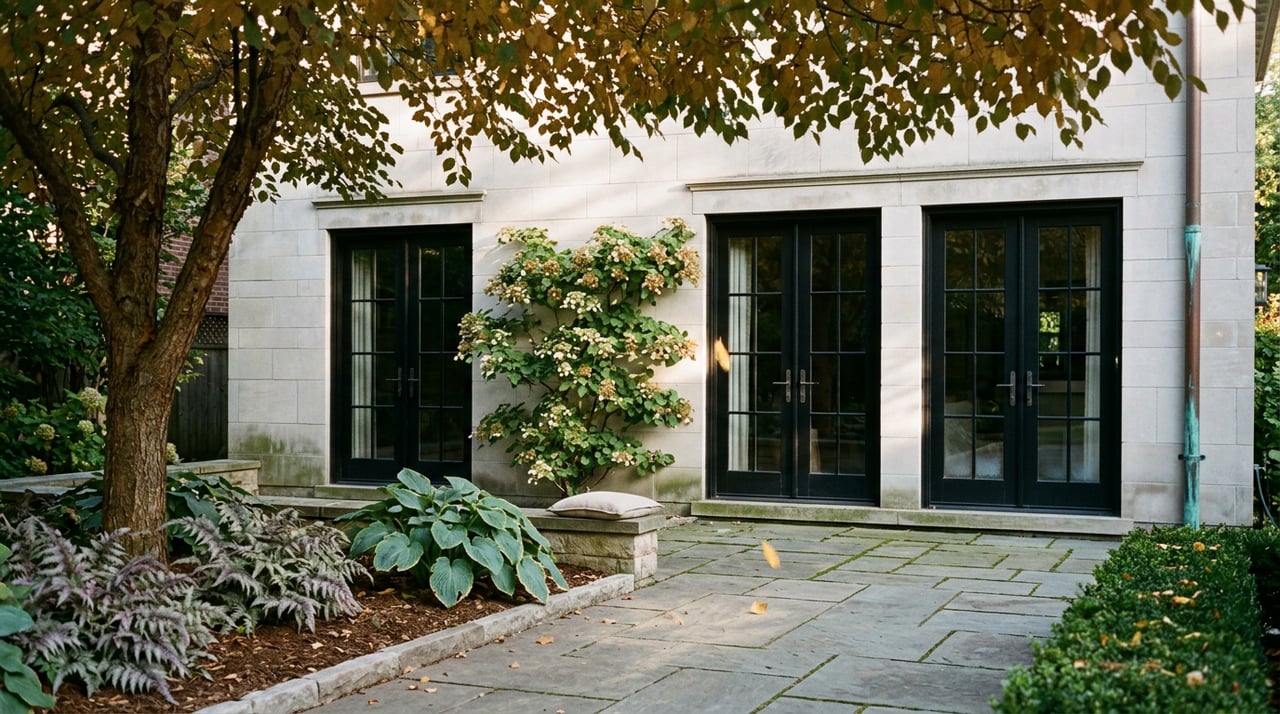
Take a Lytton Park Toronto Walk Through Hidden Green Space
August 20, 2026
August 20, 2026
Drive north on Avenue Road past Lawrence and you will pass the entrance to Lytton Park a dozen times without knowing it. There is no sign at eye level from a car, no gate that reads as anything but a gap in the hedge. The land drops away to the right, behind a line of mature trees, and the traffic noise that fills the car simply stops existing thirty feet below the road. Most people who have lived in this neighbourhood for years have never walked down into it.
That is the actual shape of the place. Lytton Park, the neighbourhood, takes its name from a park that sits in a valley below the street carrying its traffic, hidden by tree cover from the road above it. The park did not move. The road grew louder and wider around it, and the park simply stayed where it was, doing the same quiet things it has done for over a century.
What is down in that valley is older than most of the houses around it. In 1912, a North Toronto resident named Edward B. Stockdale founded the North Toronto Lawn Bowling Club on his own property, building the bowling greens and a small clubhouse that he leased to members. The club's original mandate covered lawn bowling, curling, skating, and tennis, essentially every outdoor amusement a family might want across two seasons. A tennis facility followed in 1919. Stockdale sold the property to the City of Toronto in 1921, and the city formally established Lytton Park as a subdivision in 1928, a full sixteen years after the bowling club that gave the valley its social life.
That sequencing matters. The neighbourhood did not get a park built for it after the houses went up. The park came first, run by volunteers and a private landowner, and the neighbourhood assembled itself around a patch of green that already had a clubhouse and a tennis net.
The club has kept renewing itself rather than simply persisting. In 2004 the executive brought on part time managers to handle seasonal operations. By 2006 the club had extended its hours to a full day operation with city approval, closer to its founding structure than the limited-hours version it had become. And the North Toronto Tennis Club, as it now operates at 200 Lytton Boulevard, lists a newly formed social committee for 2026, a small but real sign that a hundred and fourteen year old institution is still adding to itself rather than coasting on its own history.
If you walk into the valley today, in the middle of August, here is what you will find:
None of this required a renovation announcement or a ribbon cutting to exist. It has simply been running, quietly, since before most of the streets around it were paved.
A neighbourhood's name usually points backward, at something that used to be there. Lytton Park points down, at something that still is.
Directly across from the park sits the Herbert Begg Memorial Garden, a strolling garden that Begg's daughters donated to the city as a memorial to their father. It is not a large space and it does not announce itself with signage that reads from a moving car either. It rewards the kind of walk where you are actually looking rather than passing through.
Late summer is a reasonable time to make that walk. The garden is planted for a stroll, not a destination, which is exactly the kind of green space that gets skipped by people rushing between the tennis club and their car. If you have already made the trip down into the valley to see the courts, the garden costs you another two minutes and a street crossing.
The third piece of this loop sits a short walk north, off Rosewell Avenue. Otter Creek Park holds a twin outdoor rink, the kind built for hockey and public skating through the winter months. In the summer, that same rink surface gets used for skateboarding, a repurposing that has nothing to do with any official program and everything to do with a flat, enclosed concrete surface that is otherwise sitting empty for half the year.
The public schools next to Otter Creek add a running track, a baseball diamond, and a basketball court to the same stretch, along with tobogganing hills that will matter again in about four months. In August, the rink-turned-skate-surface and the ball diamond are doing the actual work, while the hills wait their turn.
Put together, the three stops, the valley courts, the memorial garden, and the Otter Creek rink, form a loop that a resident could walk in under half an hour without crossing a single stretch of retail. That is unusual for a Toronto neighbourhood walk. Most of them run through commercial strips by design. This one runs through green space almost the whole way, and the retail only shows up if you choose to route yourself past it on the way back.
Lytton Park's commercial history has been less durable than its park. The neighbourhood once had a racetrack near Glengrove Avenue and Yonge Street that opened in 1887 and closed after only two years. It had a castle, known as Glen Castle or Ainsley Castle, that once stood on the hill where Glen Castle Street now runs. Neither survived. The valley park did, along with the lawn bowling club that has occupied the same ground since 1912.
That is the actual argument for treating the park loop as the neighbourhood's real centre rather than whatever storefronts happen to be leasing space on Avenue Road or Yonge this year. Storefronts turn over. A racetrack can run for two years and vanish. A castle can come down. A valley with a tree canopy thick enough to block out traffic noise, and a bowling club old enough to have outlived three different tenant configurations at street level above it, is a much harder thing to replace.
If you have lived in Lytton Park for years and have genuinely never walked down into that valley, this month is as good a time as any. The tennis courts are active, the bowling greens are in season, the garden across the street is past its spring peak but still worth the crossing, and the rink up on Rosewell is doing its summer job as a skate surface before the ice comes back. None of it requires a plan. It just requires knowing it is there, thirty feet below the road you drive every day.
For more on what makes this stretch of Midtown Toronto tick, from the streets to the school catchments to the market itself, Courtney Smith writes about Lytton Park and the neighbourhoods around it from the inside. Let's Connect if you would like a longtime local's read on where you live now, or where you are thinking about landing next.
Stay up to date on the latest real estate trends.
Every client deserves a strategy tailored to their goals. With trusted market knowledge, clear communication, and dedicated guidance, Courtney is committed to helping you achieve the best possible outcome.