The Word "Ravine" Means Two Different Deals in Lawrence Park
August 27, 2026
August 27, 2026
Two listings can both say "ravine" in the description and still commit their buyers to entirely different closings. One sits across the street from the tree line, borrowing the quiet and the view without ever touching the boundary. The other backs directly onto it, its rear yard resting inside a line the City of Toronto drew on a map years ago, one that most buyers never think to check before they write an offer.
In November 2025, a one-bedroom unit at 3018 Yonge Street sold for $1,185,000 after starting at $1,325,000 and settling to $1,249,900, according to the Globe and Mail's account of the deal. Part of the pitch was its position, in a building across from Lawrence Park Ravine and the subway. That transaction never had to touch a tree permit or a boundary survey. It simply looked at the ravine from the far side of Yonge Street. A detached house two streets over that backs onto the same ravine system is playing an entirely different game, one that starts before the closing date and can run for months afterward.
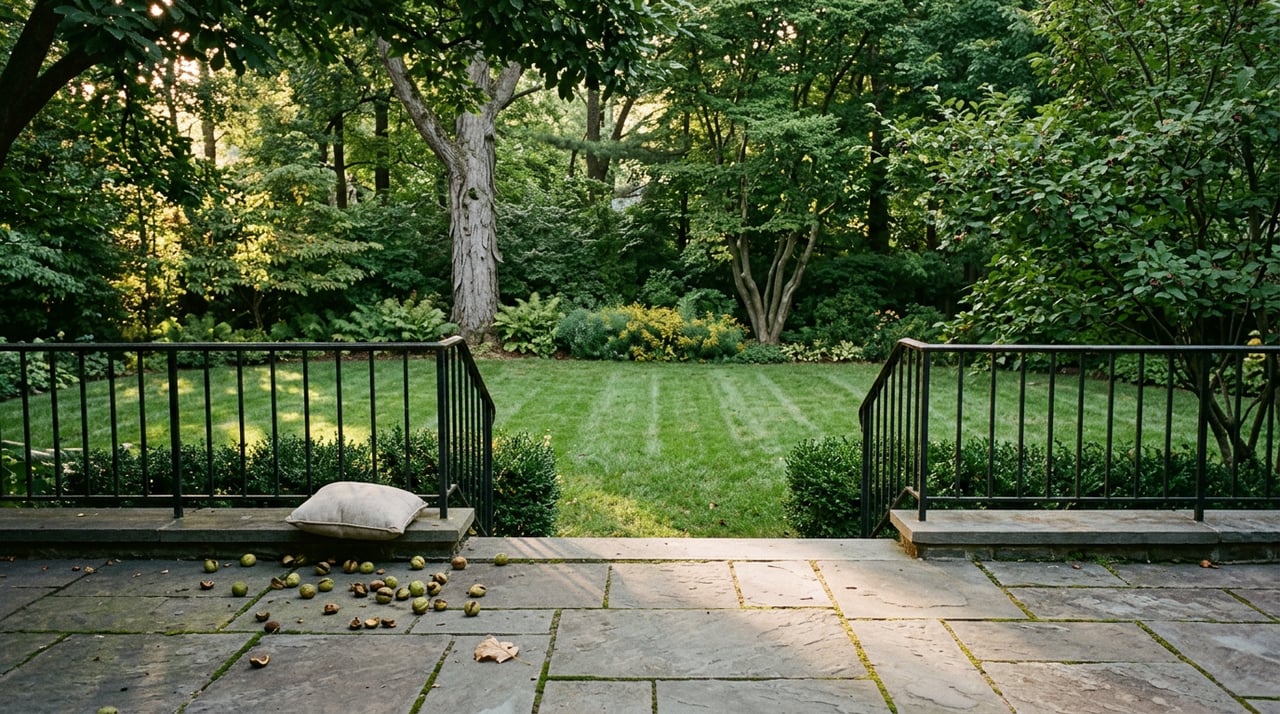
Lawrence Park's historical core runs along Blythwood Ravine to the south, touches Chatsworth Ravine, and threads the Lawrence Park Ravine footpath past the tennis courts, the lawn bowling green, and Alexander Muir Memorial Gardens. Plenty of the neighbourhood's curving streets sit close enough to feel the effect, which is exactly why the address does work on a listing sheet. But "ravine adjacent" is a marketing phrase, not a legal one. What actually governs a transaction is whether the lot's own property line falls inside the boundary the City has mapped, a boundary that has nothing to do with how good the view is from the kitchen window.
The bylaw's own definition of a ravine sets a fairly low bar for what qualifies: a landform with at least a two metre change in grade between its highest and lowest points, some vegetation cover, and a history of water flowing through or beside it. A backyard that slopes gently toward an old drainage line can meet that test even if nobody on the street would call it a canyon. That is worth knowing before you assume your lot is exempt just because it does not look dramatic from the patio.
Toronto actually runs two separate tree rules, and mixing them up is where buyers get caught off guard. The city-wide private tree bylaw protects trees 30 centimetres or more in diameter no matter where they stand. Chapter 658, the Ravine and Natural Feature Protection By-law, works differently: inside a mapped ravine or natural feature area, it protects a tree of any species and any size. The same rule that covers a tree estimated at more than 150 years old also covers a sapling planted five years ago, because the trigger is location, not age or trunk diameter.
Where a Lawrence Park lot also falls inside a Toronto and Region Conservation Authority regulated area, a second layer applies on top of the City's rule. TRCA regulates development within 120 metres of a watercourse, wetland, or ravine under the Conservation Authorities Act and provincial regulation, and its own staff have said plainly that most homeowners have never heard of TRCA until a project brings the two into contact. Neighbourhoods sitting along the tributaries that feed the Don River, Lawrence Park among them, carry more of this overlap than most buyers assume walking in.
A current survey plotting the protection limit or TRCA boundary is supposed to exist before an offer becomes firm. In practice, it usually gets ordered after the buyer has already waived financing and inspection conditions, which is precisely the moment the timeline problem shows up. TRCA review of a straightforward project commonly takes six to twelve weeks, and larger applications that need geotechnical or arborist reports can stretch to several months. Permit and consultant costs for a typical ravine or TRCA application run roughly $1,500 to $5,000, and homeowners planning a larger custom build have reported paying $10,000 or more once engineering and arborist reports are added to the file.
Before waiving any condition on a lot that touches or approaches the ravine system, it is worth confirming:
In July 2026, new listings across the Greater Toronto Area fell 17.8 percent year over year to 14,484, while active listings dropped 12.1 percent to 26,098, according to the Toronto Regional Real Estate Board's July 2026 Market Watch. Detached prices softened over the same period, averaging $1,291,690 region-wide, down 5.1 percent from July 2025. Put those together and the picture for a ravine-adjacent buyer changes shape. A softer price does not mean a softer process. Fewer new listings means fewer comparable ravine-backing homes to point to if a seller declines to extend a closing date for a permit review, and a buyer who discovers the regulatory overlay after removing conditions has far less room to renegotiate than they would in a market stocked with alternatives.
Lawrence Park's own detached market has historically rewarded well-priced homes with speed rather than patience. As of the third quarter of 2025, detached sales in the neighbourhood averaged 96 percent of asking price on roughly 37 days on market, a pace with little slack built in for a buyer to slow-walk a survey after the fact. The risk shows up starkly in how some of these homes trade. In April 2026, the Globe and Mail reported on a Lawrence Park semi-detached listed under $1.4 million that drew more than 80 visitors and three bids in a single week, with the winning offer coming in $52,000 over asking and free of conditions. "When we were out, there weren't any semis out in Lawrence Park," the listing agent told the paper. A condition-free offer is exactly the kind of bid that skips the step where a ravine boundary issue would normally surface, which is fine if the lot has nothing to do with the ravine system and a real problem if it does.
For a seller, this cuts the other direction. A ravine-backing property that lists without a current survey or any indication of where the protection line sits invites a buyer's lawyer to build extra time into the condition period, which slows the entire deal. Sellers who have already had the boundary confirmed, and who can say plainly whether their own planned improvements would trigger a permit, remove one of the more common places a Lawrence Park deal stalls partway through. Custom rebuilds in the neighbourhood typically run $450 to $650 or more per square foot for construction alone, with full project timelines of twelve to eighteen months before ravine setbacks are even factored in. A buyer weighing a future rebuild on a ravine lot needs that number going in, and a seller who hands over the paperwork that speeds the process is offering something a buyer's lawyer will actually notice.
Possibly. Chapter 658 covers grading, fill, and new or replacement structures within the mapped area, not only major construction. If the deck or fence sits inside the protection limit, it needs a permit regardless of its size.
Then the City's ravine bylaw and TRCA's regulated area most likely don't apply to your lot at all, the same way the unit across from Lawrence Park Ravine on Yonge Street never had to file a ravine permit. The view and the regulation are separate things, and only a survey checked against the City's mapping tool tells you which one you're dealing with.
Before the offer becomes firm, ideally. Waiting until after conditions are waived is the most common reason a Lawrence Park ravine transaction runs into a timeline problem that could have been sorted out earlier.
It depends on the individual lot. Some fall only within the City's Chapter 658 boundary, others also sit inside TRCA's regulated area, and the two authorities review separately. Checking both, rather than assuming one covers the other, is what keeps a buyer or seller from a surprise partway through the file.
If you're weighing a ravine-backing property in Lawrence Park, whether you're the one selling it or the one hoping to build there down the line, the paperwork is worth sorting before you write or accept an offer, not after. Courtney Smith works these streets regularly and can help you get the right survey done and the right questions answered early. Let's Connect.
Stay up to date on the latest real estate trends.
Every client deserves a strategy tailored to their goals. With trusted market knowledge, clear communication, and dedicated guidance, Courtney is committed to helping you achieve the best possible outcome.